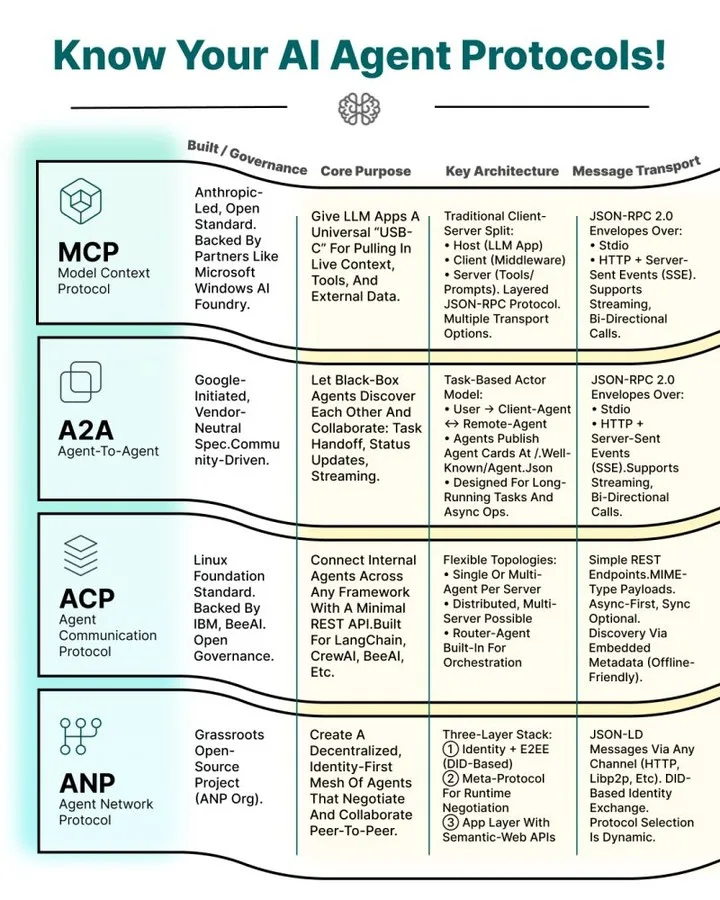
Hello, everyone! This is the first time I share content from Alex Wang — and certainly not the last. Her insights on multi-agent systems are always sharp and practical. 👏 This graphic caught my attention because it clearly breaks down four key protocols that power modern multi-agent AI systems — and interestingly, many of these ideas can also inspire how we think about projects and team coordination. MCP, or Model-Context Protocol, gives AI models structured awareness of their environment, tools, and goals. In a project context, this is like ensuring every team member has the full context — objectives, constraints, and dependencies — before acting. It’s “context-as-code” for both machines and teams. A2A, or Agent-to-Agent Protocol, enables multiple agents to collaborate, each with specific roles and responsibilities. This directly mirrors project structures, where tasks are divided, delegated, and synchronized to achieve complex outcomes. ACP, the Agent Communication Protocol, defines how agents communicate with structured intent — every message has a clear purpose. In projects, this is the essence of effective communication plans: clarity, intent, and traceability of every exchange. Finally, ANP, or Agent-Network Protocol, allows scalable collaboration across distributed systems. Think of this as the network of projects and teams across organizations — interconnected, autonomous, but aligned through shared frameworks and communication standards. So... when to use each? ✅ MCP → Give your model or team full context ✅ A2A → Enable collaboration through clear roles ✅ ACP → Communicate with structured intent ✅ ANP → Scale coordination across distributed networks Four building blocks, each solving a different piece of the puzzle — whether in AI systems or in project ecosystems. Together, they enable smarter, modular, and more adaptive collaboration. Ricardo #AI #MultiAgentSystems #ProjectManagement #Innovation #FutureOfWork #ArtificialIntelligence